Choosing between panel lights and downlights is not a simple matter of appearance. It affects brightness, comfort, energy use, installation work, and the atmosphere of a room. Many buyers ask, “what is the difference between panel lights and downlights?” The answer begins with how each fixture distributes light.
Panel lights usually create broad, even illumination across ceilings. Their large diffuser can reduce harsh shadows over desks, counters, and classroom tables. A 600-by-600-millimeter LED panel often suits offices and commercial interiors with regular ceiling grids. Downlights work differently. They send focused beams downward, creating stronger visual accents around furniture, artwork, kitchen islands, or walkways. However, poorly positioned downlights may produce glare or dark patches.
As respected American lighting designer Richard Kelly stated, “The quality of light is more important than the quantity of light.” This principle remains practical today. A brighter room is not automatically a better room. Consider ceiling height, beam angle, mounting depth, color temperature, dimming compatibility, and maintenance access before choosing.
Real projects often need both systems. A panel light may provide comfortable general lighting, while adjustable downlights add depth and direction. Yet this approach can become wasteful without a lighting plan. I have seen spaces with attractive fixtures that still feel uncomfortable because every beam points at eye level. That mistake deserves attention. The following guide compares panel lights and downlights through performance, design flexibility, installation requirements, and long-term operating value.
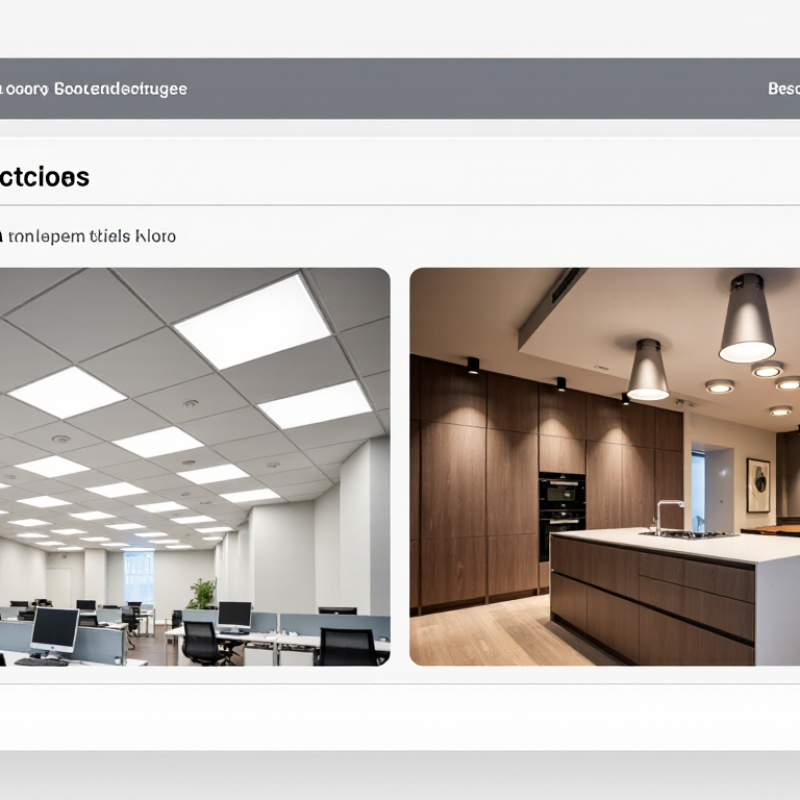
Panel lights are broad, flat LED fixtures designed to spread light across a wide area. They usually contain a diffuser, LED modules, and a driver. Common forms include recessed, surface-mounted, and suspended units. The diffuser softens bright points and reduces harsh shadows on desks or floors. Panel lights suit offices, classrooms, corridors, and kitchens needing even illumination. Their slim bodies work well where ceiling space is limited. However, poor diffuser quality can create glare.
Downlights are compact ceiling fixtures that send light mainly downward. Many use a recessed housing, trim, reflector, and integrated or replaceable light source. Fixed downlights provide general lighting. Adjustable versions can aim at artwork, shelves, or work surfaces. Beam angle changes the result. Narrow beams highlight objects, while wide beams spread illumination. Installation requires accurate cutout sizing, safe wiring, and enough space for heat management. An electrician should verify circuit compatibility and local code requirements. Consider room height, brightness, color rendering, glare control, and suitable protection for damp areas. Appearance alone can mislead. The boundary is not perfect. Some slim fixtures behave like both. That overlap can complicate planning, especially in small rooms. A quick ceiling sketch often prevents misplaced lights and dark corners.
This chart compares representative typical beam angles for LED panel lights and recessed downlights. Panel lights commonly distribute light across a wide angle of about 100–120°, making them suitable for broad, uniform illumination in offices, classrooms, and other large spaces. Downlights generally use a narrower beam of about 24–60°, producing more focused light for homes, corridors, retail displays, and accent lighting. Actual specifications vary by fixture design and application.
Panel lights and downlights differ most clearly in their optical design. A panel light spreads illumination across a broad, flat surface. A 600-by-600-millimeter panel can create a calm ceiling grid with fewer bright spots. Its diffuser softens shadows and supports even task lighting in offices, classrooms, and clinics. The trade-off is visual uniformity. Some low-cost diffusers can look slightly dull or produce edge shadowing.
A downlight concentrates light through a smaller recessed aperture. Its reflector, lens, and trim shape the beam, often from narrow to wide. This design creates stronger contrast on counters, artwork, tables, and circulation paths. It also leaves more ceiling visible between fittings. However, poor aiming can produce scalloped walls or uncomfortable glare. The Illuminating Engineering Society’s LM-79 testing method measures electrical and photometric performance, including luminous output and efficacy. Designers should request those test results, not rely on wattage alone.
Efficiency does not decide the form. The U.S. Department of Energy reports that LED products use at least 75% less energy and last up to 25 times longer than incandescent lighting. That figure applies broadly, not equally to every panel or downlight. Controls, heat management, optics, and installation quality still matter. A panel usually suits uniform ambient light. A downlight suits layered, directional lighting. In practice, mixing both can work better, although the ceiling may become visually busy. That detail is easy to underestimate.
| Design Dimension | Panel Lights | Downlights |
|---|---|---|
| Basic form | A broad, thin rectangular or square luminous surface designed to sit flush or nearly flush with the ceiling. | A compact circular or square fitting that directs light downward through a trim, reflector, or lens. |
| Typical installation | Commonly recessed into suspended ceilings, surface-mounted, or suspended using a cable kit. | Usually recessed into a cut-out in a plasterboard, gypsum, or other suitable ceiling; surface-mounted versions are also available. |
| Light distribution | Broad and relatively uniform, helping illuminate a large area with fewer noticeable bright spots. | More concentrated and directional, with the beam spread determined by the optic, reflector, and trim. |
| Common beam angle | Often wide, typically around 100°–120°, although the exact angle varies by diffuser and optical design. | Often narrow to wide, commonly about 24°–60°, depending on the intended task and optical system. |
| Visual appearance | Creates a clean ceiling plane with a large, softly glowing surface and limited visual interruption. | Creates repeated points of light that can add rhythm, contrast, and visual emphasis to a ceiling. |
| Typical shapes and sizes | Common formats include 600 × 600 mm, 600 × 1200 mm, and smaller square or rectangular modules. | Common cut-out diameters are approximately 65–200 mm, with square formats and larger architectural sizes also available. |
| Typical power range | Often approximately 24–60 W for general indoor panels, depending on dimensions, efficiency, and target illuminance. | Often approximately 5–30 W for individual indoor downlights, depending on aperture, beam angle, and required output. |
| Illumination pattern | Well suited to general or ambient lighting across offices, classrooms, corridors, retail areas, and other open spaces. | Well suited to task lighting, accent lighting, perimeter lighting, and layered lighting schemes. |
| Glare control | A micro-prismatic or low-glare diffuser can distribute luminance over a broad surface; performance depends on the diffuser and viewing angle. | Deep-set light sources, baffles, frosted lenses, and suitable beam angles can reduce glare; poor positioning may create high-brightness points. |
| Ceiling effect | Produces a more continuous and visually calm ceiling appearance. | Produces a patterned ceiling with individual light sources and stronger pools of illumination. |
| Installation planning | Requires accurate module alignment, adequate ceiling support, and sufficient space for the driver and wiring. | Requires precise cut-out placement, spacing calculations, clearance from insulation where applicable, and driver access. |
| Maintenance access | Large panels can be relatively easy to remove from accessible suspended ceilings, but replacement may involve handling a larger fitting. | Individual units are compact and can be replaced separately, although access may be difficult in high or finished ceilings. |
| Best design choice | Choose panels when broad, even illumination and a minimal ceiling pattern are the main priorities. | Choose downlights when directional control, visual layering, accenting, or flexible spotlighting is more important. |
| Important specification factors | Check lumen output, efficacy, glare rating, color temperature, color-rendering quality, dimming compatibility, dimensions, and ceiling type. | Check lumen output, beam angle, cut-out size, glare rating, color temperature, color-rendering quality, dimming compatibility, and installation clearance. |
Note: The power ratings, beam angles, dimensions, and optical characteristics shown are typical ranges for indoor LED products. Actual performance varies by product construction, ceiling conditions, optics, diffuser, and lighting requirements.
Panel lights and downlights differ mainly in how they distribute light and how they enter a ceiling. A panel light spreads illumination across a broad, usually diffused surface. Many commercial panels deliver beam angles near 100–120 degrees, reducing harsh shadows over desks. Downlights use a recessed reflector or lens. Their typical beam angles range from 24 to 60 degrees, creating focused pools of light. The exact result depends on ceiling height, lens design, and spacing.
Installation reveals another important difference. Panel lights commonly fit modular ceiling grids or require a larger recessed opening. Suspended mounting is also practical in open offices. Downlights need individual cutouts, sufficient ceiling depth, and careful spacing around joists and services. In bathrooms or insulated ceilings, the installer must also check the fixture’s protection and thermal requirements. Small mistakes show quickly.
The International Energy Agency estimates lighting uses about 15% of global electricity. Therefore, distribution affects comfort, not only energy use. A room with poorly spaced downlights may need higher output, while a well-planned panel layout can reduce contrast. The U.S. Department of Energy also identifies controls and efficient solid-state lighting as major opportunities for reducing building energy demand. Still, wider light is not automatically better. Panels can create an overly flat appearance. Downlights can produce glare on screens. A practical mock-up, measured with a lux meter, is more reliable than relying on drawings alone. This step is often skipped.
What Is the Difference Between Panel Lights and Downlights?
Energy Use, Maintenance, and Lifespan
Panel lights spread light across a wide, even surface. They suit offices, classrooms, and shops with regular ceiling grids. Downlights send narrower beams downward. They work well over counters, tables, corridors, and display areas. A 36-watt panel may illuminate a larger workspace than several small downlights, but room shape matters. More fixtures can increase total energy use.
In maintenance inspections, dust around a panel’s rear vents often traps heat. Heat can shorten the life of the LED driver. Downlights have smaller housings, so poor ventilation can create a similar problem. Keep insulation away from fixtures unless the fitting allows direct contact. This detail is easy to miss. Cleaning lenses twice a year can preserve brightness, especially in kitchens or workshops.
LED panels and downlights may be rated for many years, often around 30,000 to 50,000 operating hours. Real service life depends on heat, switching frequency, voltage stability, and driver quality. The LED chip may still work when the driver fails. Replacing a panel is usually straightforward if its size matches the ceiling opening. Downlight replacement can be messier because trim colors fade and cut-out sizes vary. I have seen supposedly long-life fittings fail early in hot, enclosed ceilings. Lifespan figures are useful, but they are not promises.
Choosing the Right Fixture for Different Spaces
Panel lights spread light through a broad, even surface. They work well in offices, kitchens, classrooms, and low-ceiling rooms. Their softer distribution reduces harsh shadows over desks and worktops.
Downlights sit inside the ceiling and send light downward. They suit corridors, bathrooms, display areas, and rooms needing layered illumination. The beam can feel precise. Yet poor spacing may create dark patches between fixtures.
When choosing, measure ceiling height, task locations, and surface colors. A white kitchen may need fewer fixtures than a dark wood room. For a desk, place light slightly forward to limit hand shadows. In bathrooms, select a suitable moisture-rated fitting and follow local electrical requirements. Check color rendering, glare control, dimming compatibility, and replacement access. These details matter more than appearance alone.
I once preferred a neat row of downlights, but the room felt bright near the doorway and dim beside the sofa. The layout looked balanced on paper. It was not.
Panel lights are often better for broad ambient lighting. Downlights work well for accents, circulation, and focused tasks. Many spaces benefit from both options.
Use a panel for general brightness, then add downlights above artwork or a sink. Keep spacing consistent, but do not treat formulas as absolute. Furniture changes the result.
Test one fixture at night before installing a full grid. A small mock-up can reveal glare, shadows, and an uncomfortable color tone. At night, the real room may disagree with the ceiling plan.
Panel lights are broad, flat LED fixtures that spread light evenly. They usually include a diffuser, LED modules, and a driver. They suit offices, kitchens, classrooms, and low ceilings. The diffuser softens bright points. Poor diffusers can still cause glare.
Downlights are compact ceiling fixtures that direct light mainly downward. Fixed versions provide general lighting. Adjustable versions can highlight artwork, shelves, sinks, or work surfaces. Their beam angle controls coverage. Narrow beams create focused highlights. Wide beams spread farther.
Panel lights usually create broader, more uniform illumination. They work well above desks, counters, and classroom tables. Downlights can leave dark patches when spacing is poor. A ceiling sketch may prevent misplaced fixtures.
Yes, many rooms benefit from both types. Use a panel for general brightness. Add downlights near artwork, a sink, or a display shelf. This arrangement can feel balanced. Not always, though. Furniture may change the result.
Measure ceiling height, work areas, and surface colors. A white kitchen may need fewer fixtures than a dark wood room. Place desk or counter lighting slightly forward to reduce hand shadows. Bathrooms need suitable moisture protection and safe installation. Follow local electrical requirements.
Fixture wattage, quantity, room shape, and operating time all matter. One larger panel may light a workspace more efficiently than several downlights. However, extra fixtures can raise total consumption. Compare the complete layout, not one fitting.
Many LED panels and downlights are rated for about 30,000 to 50,000 hours. Actual life depends on heat, switching, voltage stability, and driver quality. A driver may fail before the LED chip. Long-life ratings are useful, but not promises.
Clean lenses about twice yearly, especially in kitchens or workshops. Check rear vents and small housings for dust. Dust can trap heat. Keep insulation away unless the fitting permits contact. Replacement may be difficult when cutout sizes differ. I would test one fixture first.
What is the difference between panel lights and downlights? Panel lights are broad, flat fixtures that produce an even, widespread glow, making them suitable for offices, classrooms, kitchens, and other areas where uniform illumination is important. Downlights are compact, recessed or surface-mounted fixtures that direct light downward in a focused beam. Their smaller size and directional output make them useful for accent lighting, task lighting, hallways, and spaces where specific areas need emphasis.
The main differences involve design, light distribution, installation, and maintenance. Panel lights generally cover more space with fewer fixtures and offer a clean, modern appearance, while downlights provide greater flexibility for layered lighting but may require more units to achieve consistent brightness. Both can be energy-efficient when equipped with suitable LED technology, and their lifespan depends on construction quality, operating conditions, and usage. When choosing between them, consider the room’s size, ceiling structure, desired atmosphere, brightness requirements, installation access, and long-term maintenance needs.

Velvet Light